emfor is an open-source health-check daemon that runs on every application host. It checks the backends of the services your applications use and writes which ones are healthy into a local file; applications ask a client library which backend to connect to and get an answer in about a microsecond, without a network round trip.
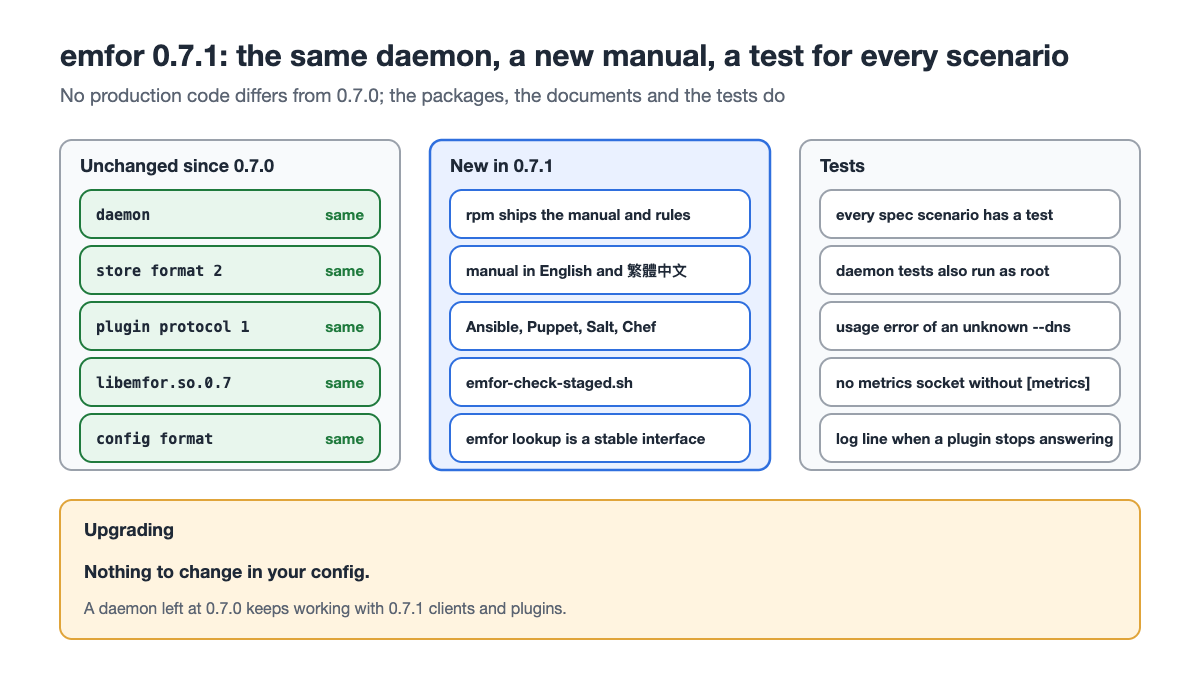
0.7.1 was released on 2026-11-22, the same day as 0.7.0. The daemon, the store format (2) and the plugin protocol (1) are unchanged, and no production code differs from 0.7.0. libemfor is still libemfor.so.0.7. This release is about the packages, the documents and the tests. If you run 0.7.0, you do not need to upgrade for any fix, but the rpm and the manual are better.
1. What changed
- The rpm ships the manual and the Prometheus rules, as the deb does:
/usr/share/doc/emfor/manual/and/usr/share/doc/emfor/examples/prometheus/. - A new user manual, in English and Traditional Chinese, in place of the earlier set of documents. The chapter numbers changed, so older changelog entries that link to files such as
docs/manual/03-configuration.mdnow point at files that are gone. - Managing emfor with Ansible, Puppet, Salt or Chef. A new section of chapter 5 says where the usual defaults of such tools do not fit: reload, not restart;
check-configas the daemon’s user; the owner and mode rules of the files. The new examples/deploy/emfor-check-staged.sh checks oneconf.dfile before it replaces the old one, so you can hand it to the validation option of your tool. We tried it with Ansible 2.14, Puppet 7.23, Salt 3008 and Cinc Client 19.4, the free build of Chef Infra Client. We did not try Progress’s own Chef client. - docs/compatibility.md lists
emfor lookupamong the stable interfaces: the address line without--explain, and--json.
2. Tests
Every scenario and example in the specs now has a test that names it in a spectra-scenario comment, and a check of the specs against those comments finds none missing. An independent review of the marks found one wrong (removed) and a number that cover only part of a scenario; most of those are tests that need Docker or root, or an example table split over several tests.
The CI has a new job that runs the daemon’s tests as root in a container, because the owner checks of the config files and the peer secret give a file to another user, which only root can do. A test of the deploy script and a test of the default build of the Rust client run there too. Several tests now check more than they did: the usage error of an unknown --dns family, that a daemon without a [metrics] table opens no socket, and the log line when a plugin stops answering.
3. How to upgrade
There is nothing to change in your config. Install the 0.7.1 package as usual; a daemon you leave at 0.7.0 keeps working with the 0.7.1 clients and plugins.
The full list of changes is in the CHANGELOG, and the source is in the v0.7.1 release on GitHub.
💡 Technical collaboration and architecture consulting
Are your services struggling with inconsistent health checks, slow failure detection, or check traffic that weighs on your backends? We can help you assess your architecture and adopt the health-check and service-discovery approach that fits.